|

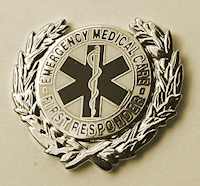 People's lives
often depend on the quick reaction and competent care of emergency medical
technicians (EMTs) and paramedics. Incidents as varied as automobile
accidents, heart attacks, slips and falls, childbirth, and gunshot wounds
all require immediate medical attention. EMTs and paramedics provide this
vital service as they care for and transport the sick or injured to a
medical facility. People's lives
often depend on the quick reaction and competent care of emergency medical
technicians (EMTs) and paramedics. Incidents as varied as automobile
accidents, heart attacks, slips and falls, childbirth, and gunshot wounds
all require immediate medical attention. EMTs and paramedics provide this
vital service as they care for and transport the sick or injured to a
medical facility.
In an emergency, EMTs and paramedics are typically
dispatched by a 911 operator to the scene, where they often work with
police and fire fighters. Once they arrive, EMTs and paramedics assess the
nature of the patient's condition while trying to determine whether the
patient has any pre-existing medical conditions. Following medical
protocols and guidelines, they provide appropriate emergency care and, when
necessary, transport the patient. Some paramedics are trained to treat
patients with minor injuries on the scene of an accident or they may treat
them at their home without transporting them to a medical facility.
Emergency treatment is carried out under the medical direction of
physicians.
EMTs and paramedics
may use special equipment, such as backboards, to immobilize patients
before placing them on stretchers and securing them in the ambulance for
transport to a medical facility. These workers generally work in teams.
During the transport of a patient, one EMT or paramedic drives while the
other monitors the patient's vital signs and gives additional care as
needed. Some paramedics work as part of a helicopter's flight crew to
transport critically ill or injured patients to hospital trauma centers.
At the medical facility, EMTs and paramedics help transfer
patients to the emergency department, report their observations and actions
to emergency department staff, and may provide additional emergency
treatment. After each run, EMTs and paramedics replace used supplies and
check equipment. If a transported patient had a contagious disease, EMTs
and paramedics decontaminate the interior of the ambulance and report cases
to the proper authorities.
EMTs and paramedics also provide transportation for patients
from one medical facility to another, particularly if they work for private
ambulance services. Patients often need to be transferred to a hospital
that specializes in their injury or illness or to a nursing home.
Beyond these general duties, the specific responsibilities
of EMTs and paramedics depend on their level of qualification and training.
The National Registry of Emergency Medical Technicians (NREMT) certifies
emergency medical service providers at five levels: First Responder;
EMT-Basic; EMT-Intermediate, which has two levels called 1985 and 1999; and
Paramedic. Some states, however, have their own certification programs and
use distinct names and titles.
The EMT-Basic represents the first component of the
emergency medical technician system. An EMT trained at this level is
prepared to care for patients at the scene of an accident and while
transporting patients by ambulance to the hospital under medical direction.
The EMT-Basic has the emergency skills to assess a patient's condition and
manage respiratory, cardiac, and trauma emergencies.
The EMT-Intermediate has more advanced training. However,
the specific tasks that those certified at this level are allowed to
perform varies greatly from state to state.
EMT-Paramedics provide the most extensive pre-hospital care.
In addition to carrying out the procedures of the other levels, paramedics
may administer drugs orally and intravenously, interpret electrocardiograms
(EKGs), perform endotracheal intubations, and use monitors and other
complex equipment. However, like EMT-Intermediate, what paramedics are
permitted to do varies by state.
Note: Some resources in this section are provided by the US
Department of Labor, Bureau of Labor
Statistics.
|
|