|

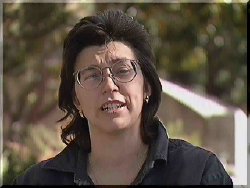 Julie
A. Pollitt, Julie
A. Pollitt,
P.E.
Aerospace Technologist - Project Manager
NASA Ames Research
Center
|

|
 MS, Mechanical Engineering, Stanford
University MS, Mechanical Engineering, Stanford
University
BS, Mechanical Engineering, University
of Connecticut
|
|

|
Aerospace
Technologist involved in project management; builds research and testing
equipment, including large-scale models for wind tunnel tests.
|
|

|
Julie likes her
job because she has to be a 'jack of all trades,' working with designers,
doing calculations, producing CAD drawings, building prototypes, and
conducting tests.
|
|

|
"On a
Bachelor's degree level, keep as broad based as possible so that you have
many, many more possibilities to go to. And think seriously about
graduate school."
|

Pollitt: "There
is a significant amount of design hours that go into building a wind tunnel
model, especially on the scales that we're talking about. -- one of the
models we're building is a 42% scale Boeing 757 which is basically half the
aircraft size."
Pollitt: "Advice?
On a Bachelor's degree level, keep as broad based as possible so that you
have many, many more possibilities to go to. And think seriously about
graduate school. I actually enjoyed graduate school more than I did
Bachelor's."
Q: How did you
decide to get into engineering? What did you major in in school?
Pollitt: Actually,
the way I got into engineering was I had always been interested in NASA. My
grandfather used to sit us down in front of the TV set every time an Apollo
mission went up, every time anything else went up. He would sit us down in
front of that TV set and say, "Watch this, this is history being
made." So from the time that I was little, I always had a real big
interest in NASA and the work that NASA did. And when I was about 16, when
I was in high school, I made the firm decision that I was going to work for
NASA no matter what. So I started talking with college recruiters and
different companies and the military and asked a lot of them what types of
degrees or what NASA would look for. I didn't come prepared with a lot of
money so I was assuming that I was going to Air Force ROTC. And I was
actually four years in a wheelchair. I was injured when I was in high
school. So they had said that engineering, aerospace engineering, would be
a good field to go into to work for NASA. And I was going to go Air Force
ROTC, become an aerospace engineer and then go on to work for NASA. But
when I got into college actually I ended up going into mechanical because
it's a little bit more broad based than aero so I figured it would cover me
in case NASA didn't want me. And then I just headed down that path. I
headed for a college for engineering. I grew up in Connecticut, so I went
to University of Connecticut, got a Bachelor's in ME and headed on and
dropped everything and left for California. Came out to NASA Ames Research
Center. Knocked on their door and asked them for a job. And fortunately,
within a day I was hired.
Q: What's it like
being a project manager?
Pollitt: I
actually enjoy being a project manager. It still allows me to keep enough
of a technical edge that I need to keep, because it's not that large of a
project where I'm not directly involved. I'm definitely directly involved
in what goes on with the design. And I've always had a natural tendency
towards leading groups and wanting to manage, organize, set a course for a
bunch of people and head them on that course. So I actually tremendously
enjoy being a project manager.
Q: What are the
challenges of being a project manager?
Pollitt: The
challenges of project management? People, working with the people. When you
end up spending 90% of your time on one or two people on the project, and
those are the people that you can't get to perform the way that everybody
else is performing. So that's probably the main challenge. Then the other
challenges that arise when people get into fights on your team. So on, so
forth. It's mostly the personnel issues.
Q: Now was there
anything in your engineering education background that prepared you for
this?
Pollitt: No,
there was nothing in my engineering education that prepared me for being a
project manager. Actually, more of the things that did prepare me was a lot of the extracurricular activities I had in
college that I was working on, as an ASME student-section rep, and the
Society of Women Engineers. There were a lot of other different societies I
was involved with. And the other big thing was playing sports, working on a
team. That was a big thing ... That's a lot of what project management and
design team is about. I mean, it's working as a team.
Q: Back to being
a student, was engineering easy? Talk about it.
Pollitt: Engineering
was never easy. (Laughing.) Engineering was never easy but on the whole,
extremely interesting and a lot of fun, I thought. I did a lot of work, had
to work very hard but having this job has certainly made any hard work I
had in school well worth the effort. And the job that I do, actually,
compared to a lot of the friends that I have that I graduated college with
or that I now that are also engineers, I actually think it's a lot more
exciting here at NASA. You get all aspects of engineering. I mean, I work
with the designer, we're doing the calculations and we're doing the design,
drawing it on the computer, heading out to the shop, having it built, testing prototype apparatus. We get the whole realm of
engineering which makes working at NASA really exciting. Whereas a lot of
people I talk to in big companies, they'll have one specific area. They may
do all stress analysis or all fluids analysis or drafting. I mean, they're
not the whole broad range. We're jacks-of-all-trades. Many of us have to be
because we don't have quite the resources all the time that private
industry has.
Q: Advice to
students, if you were going to talk to a freshman or sophomore right now?
Pollitt: Advice?
On a Bachelor's degree level, keep as broad based as possible so that you
have many, many more possibilities to go to. And think seriously about
graduate school. I actually enjoyed graduate school more than I did
Bachelor's.
|
|