|

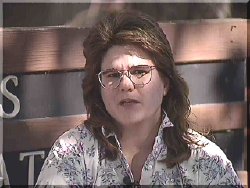 Susan
M. Susan
M.
Bowley
Aerospace
Technologist
NASA Ames Research
Center
Moffett Field, CA
|

|
 Ph.D. Candidate, University of Virginia Ph.D. Candidate, University of Virginia
MS, Mechanical Engineering, Stanford
University
BS, Mechanical Engineering, University
of Connecticut
|
|

|
Aerospace
Technologist focusing on biomedical research in the Musculoskeletal
Biomechanics Lab; analysis of heat, human factors, and load for space
shuttle.
|
|

|
Sue began her
NASA career ten years before this interview as a facility engineer for
wind tunnels. For several years she developed support equipment for
transonic and later hypersonic wind tunnels. She then took advantage of
NASA professional development program through which employees can move to
different areas of interest which brought her to life sciences to
actually build a human powered centrifuge. It's powered by bicycles and
they're going to be using it for research. She's been in biomechanics
research ever since.
|
|

|
"What's
most valuable really -- in anything -- is persistence and accomplishing
your goals."
|

Bowley: "What
I think basically got me the job here was lab experience that I had. When I
was an undergrad, I worked in the food mechanics lab. And there was a lot
of experimental stuff that I did, all four years during the summertime and
part-time during the school year. So I didn't do a coop but I had that lab
experience. That's what really what got me the job here."
Q: How did you
get started in mechanical engineering first?
Bowley: Well,
my dad was a Mechanical Engineering professor at UConn and when I was in
high school, I originally wanted to go into physics. But he's the one who
sort of convinced me that engineering would be more application-based
instead of theoretical-based. I always liked physics because I thought it
was really great that you didn't have to, like, go do something. You could
figure it out on paper, you know, and then you could check it by doing
whatever.
Q: Is that true?
Is that the way it's actually worked out?
Bowley:
Yeah. I mean, to me, the value is of engineering is that you can experiment
forever but you could get to a much quicker answer if you could analyze
something first and then experimentally determine something afterwards.
Q: When you were
a student, what were you interested in?
Bowley: Actually,
when I was in high school, I was considering being a French major because I
like foreign languages. But I didn't think it was challenging enough for
me. It was very easy and I'd rather do something more challenging. I was
interested in nature, and studying nature and
science weren't so easy.
Q: How has this
job changed with NASA over the time that you've been here?
Bowley: Well,
originally I was a facility engineer for a wind tunnel. And I worked there
for about three years. That was fun because it was a lot of fieldwork. You
could be outside crawling around in the wind tunnel. These things are huge,
like submarines. There were always problems and it was exciting to always
have a problem to work on, to think on your feet, you know. And most of it
wasn't analyzing really huge problems, at your desk or anything. But, from
there, I worked in a transonic tunnel for two years. And then I worked in a
hypertunnel-blowdown wind tunnel, which has
different support systems. It was a different type of facility, so, again,
it was the whole "learning-new-stuff-over-again" thing. That's
when I did the baby project for my graduate work -- not related to NASA.
And then I did a professional-development program that they have here in
the center, where you can move to different areas that are interesting to
you for career development. And then I came over to Life Sciences to build
a human-powered centrifuge. And so for a year I worked and got that thing
built. It's powered by bicycles and they're going to be using it for
research soon. But then after that, I applied for full-time graduate study,
and I went to the University of Virginia for biomedical-engineering Ph.D.
course work. Then I came back after that year and I'm trying to finish my
research project now. I just recently started working in a biomechanics lab
with Rob Whelan and Greg Wright.
Q: If you had to
do it over again, would you pick mechanical or would you go for something
else?
Bowley: For
undergraduate, I would definitely pick mechanical. The thing I liked about
mechanical is we had classes in all the other different engineering
disciplines. We had electrical engineering, computer science, chemical
engineering and related things. It really prepares you well for anything.
But I would only do biomedical engineering as an advanced degree because
it's so specialized. And I think that you need the pure engineering
discipline to be able to go into that in the future. I don't think it would
be useful doing that as an undergrad.
|
|